Most agencies start looking for WordPress developers once they start acquiring more client retainers, who come with faster turnaround expectations.
Agencies need developers who understand staging environments, plugin conflicts, QA workflows, Core Web Vitals, and white-label execution without constant oversight. In such a situation, hiring WordPress web development in India has become an integral part of the agency fulfillment model. This is not just because of cost arbitrage. The real advantage is operational scalability.
In this post, we’ll explore how agencies can tap into the white-label WordPress talent pool in India without going wrong with it.
1. Hire WordPress Programmers from India That Fit Your Agency Model
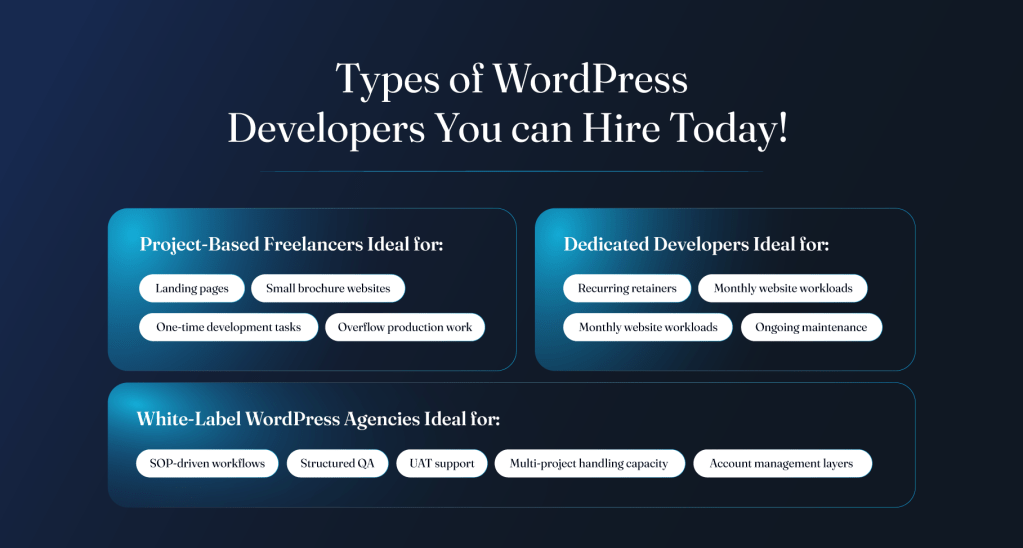
Not every WordPress hiring model solves the same operational problem. The reality is, different agency models require different fulfillment setups.
A) Project-Based Freelancers
Best suited for:
- Landing pages
- Small brochure websites
- Overflow production work
- One-time development tasks
Freelancers work well when project flow is inconsistent. But once revision cycles increase or retainers stack up, continuity and context can get lost, communication might reset constantly, and delivery quality could start fluctuating.
B) Dedicated Developers
This option is a better fit for agencies managing:
- Recurring retainers
- Monthly website workloads
- Ongoing maintenance
- Long-term client accounts
Dedicated WordPress developers in India create operational continuity. There’s less onboarding repetition with faster turnaround over time. Further, internal workflows become tighter because the developer already understands the agency’s stack, QA expectations, and deployment process.
C) White-Label WordPress Agencies
This model is built specifically for agency fulfillment. It usually includes:
- SOP-driven workflows
- Structured QA
- UAT support
- Account management layers
- Multi-project handling capacity
White-label teams are often better equipped for volume execution because their systems are already designed around agency delivery pressure.
D) Augmentation Partners
Augmentation works when agencies already have internal strategy or design teams but need backend production support. It is useful for:
- Scaling delivery bandwidth
- Handling technical overflow
- Supporting internal dev teams
- Expanding fulfillment capacity without hiring in-house
2. Technical Capability Matters, But Focus on Process Maturity More
Most agencies know how to test the technical skills of WordPress developers in India. Fewer know how to evaluate operational discipline. Here’s how to get this right.
A) Evaluate Development Standards
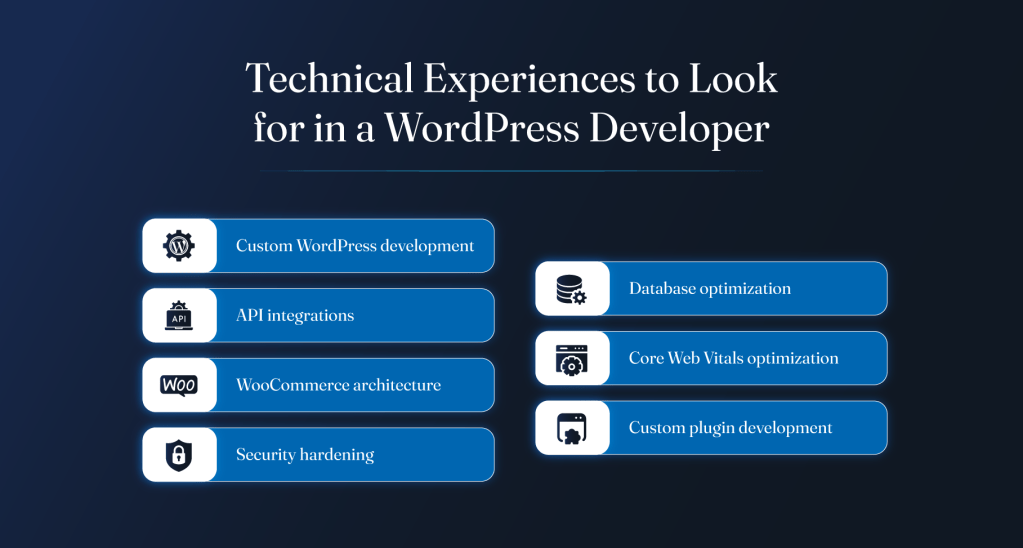
Technical capability is vital, especially when agencies manage multiple client environments simultaneously. Look for experience in:
- Custom WordPress development
- API integrations
- WooCommerce architecture
- Security hardening
- Database optimization
- Core Web Vitals optimization
- Custom plugin development
Specialization is important too. For instance, an Elementor-heavy agency needs developers who understand responsive behavior, asset loading, and builder-level optimization. WooCommerce projects, on the other hand, require a completely different experience. This might include cart flows, checkout logic, payment gateway handling, dynamic product structures. As you can tell, different stacks come with different pressure points.
B) Agencies Should Review Operational Readiness Too
Agencies review the technical output of WordPress developers in India but ignore operational systems. This can create problems during delivery in the form of missed QA checks, confusing revision loops, and production pushes without staging validation.
QA workflows are crucial because agencies cannot afford preventable mistakes across multiple active accounts. Issues such as broken forms, non-responsive layouts, checkout bugs, and browser inconsistencies create client frustration very quickly, especially during launches.
Also, good QA is not “we tested it ourselves.” Genuine QA processes involve structured validation across devices, browsers, responsive breakpoints, forms, redirects, performance metrics, and functionality testing before deployment approval even takes place.
Further, staging environments must be considered because pushing fixes directly into live production is reckless once agencies manage larger client portfolios. Every change should be validated safely before deployment. Especially when websites generate leads, transactions, or appointment bookings daily.
Ticketing systems help centralize communication and reduce scattered update requests existing on Slack threads, emails, WhatsApp messages, and random meeting notes. Operational clarity matters.
Version control is another major separator. Developers using Git workflows typically operate with far more deployment discipline than developers manually editing production files directly on live servers. One approach scales professionally. The other creates silent risk constantly.
Last but not least, deployment processes matter because launches are where weak operational systems usually expose themselves. The absence of rollback planning, deployment sequencing, and post-launch validation can mean the agency team will spend late nights fixing issues that should never have reached production.
C) Agencies Need Predictability
Agencies should hire WordPress developers in India who consistently hit deadlines, communicate clearly, follow workflows properly, and reduce operational friction over time.
Reliable workflows reduce client escalation risk because fewer surprises reach the client side. This means less scope for emergency fixes, unstable launches, and awkward account management conversations.
3. Assess Communication Like an Operations Partner
Once agencies scale, communication problems compound fast. Agencies should, therefore, evaluate communication like they are assessing an operations partner, not just a technical resource.
A) Communication Gaps Compound Under Scale
When it comes to WordPress web development in India (or anywhere else), a developer may seem perfectly responsive during onboarding. The real test begins once project pressure increases. Agencies should evaluate communication around:
- Turnaround expectations
- Time-zone overlap
- Escalation handling
- Slack/email responsiveness
- Project management discipline
- White-label communication consistency
Turnaround expectations matter because agency timelines rarely stay static. For instance, revisions arrive unexpectedly, clients change priorities mid-sprint, or launch schedules move. Agencies need developers who can communicate realistic timelines quickly instead of disappearing into vague “working on it” updates.
Time-zone overlap becomes operationally important too, especially for agencies running rapid revision cycles or same-day deployment expectations. Even a few overlapping work hours daily can dramatically improve coordination speed during active projects.
Escalation handling matters because eventually, something urgent will happen. A plugin update, for example, can break functionality, checkout might stop working, mobile layouts can collapse after deployment, or DNS changes can create downtime. Here, agencies need partners who understand incident-response behavior under pressure.
Moreover, responsiveness across Slack, email, or project management systems says a lot about operational maturity of WordPress developers in India too. Long response gaps create uncertainty, forcing account managers to spend more time chasing updates instead of managing strategy and client relationships.
Then there is white-label communication discipline. Strong white-label partners understand:
- How to communicate without disrupting agency positioning
- How to document updates clearly
- How to escalate issues professionally
- How to maintain consistency during client-facing coordination
The agency should always feel operationally in control. Good white-label communication protects that structure
Overpromising is usually the first warning sign. Experienced WordPress developers in India know complexity is in the details. So, when somebody confidently promises unrealistic turnaround timelines without reviewing requirements properly, it could be operational inexperience disguised as speed.
No clarification questions is yet another surprisingly bad sign. Strong developers usually ask a lot of operational questions early:
- Are there performance benchmarks to maintain?
- What is the approval workflow?
- Who handles QA signoff?
- Are there existing staging protocols?
- What plugin stack is already being used?
Weak documentation habits create problems later too. If updates, revisions, or deployment notes are poorly tracked, confusion eventually builds across projects. Especially when multiple stakeholders are involved internally.
Inconsistent estimates are another operational headache. Agencies need forecasting stability from their WordPress developers in India. If timelines constantly fluctuate without explanation, project planning becomes difficult across the entire pipeline.
Also, heavy plugin dependence for custom functionality warrants serious scrutiny. Installing multiple plugins to avoid writing custom functionality may look efficient initially. But eventually these plugins clash, performance degrades, updates ruin features, and maintenance overhead snowballs.
Communication quality often predicts long-term partnership success more accurately than portfolios do. Because under scale, operational clarity becomes just as valuable as technical execution itself.
4. Pricing Should Be Evaluated Against Margin and Rework Risk
Agencies obsessed with low hourly pricing usually end up paying twice. That’s because cheap development rarely stays economical once rework cycles begin.
A) Low Pricing Often Creates Bottlenecks Later
Proven WordPress developers in India know that common downstream problems include:
- Technical debt from rushed builds
- QA failures before launch
- Excessive revision cycles
- Delayed deployment schedules
- Plugin conflicts
- Rebuild costs after unstable implementations
- Client churn caused by delivery inconsistency
The problem is not just bad code, but the operational disruption surrounding it. One unstable website build can consume hours of account management, QA review, client communication, and emergency troubleshooting.
B) What Agencies Should Compare Beyond Hourly Rates
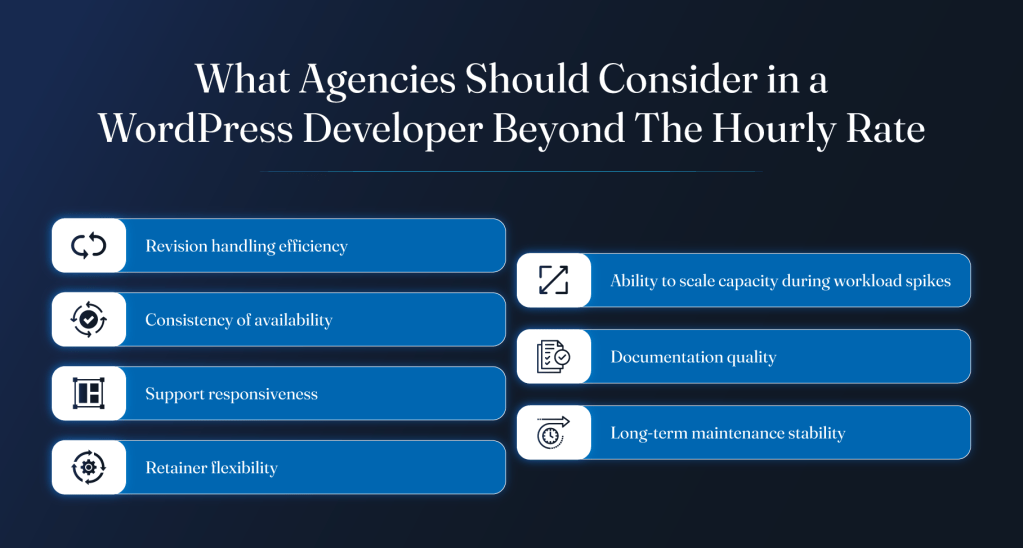
More useful evaluation metrics include:
- Revision handling efficiency
- Consistency of availability
- Support responsiveness
- Retainer flexibility
- Ability to scale capacity during workload spikes
- Documentation quality
- Long-term maintenance stability
Agencies need predictable margin protection. Reliable fulfillment systems almost always outperform low-cost sourcing models once delivery volume starts compounding.
5. White-Label Reliability Is Non-Negotiable
For agencies, their WordPress developers in India are never truly “behind the scenes.” Clients may not see them directly, but they absolutely feel the impact of their work. White-label reliability goes beyond technical execution.
A) Your Development Partner Reflects Your Agency
A strong white-label WordPress partner understands that they are operating inside someone else’s client ecosystem. This means:
- Maintaining client-facing invisibility
- Following agency communication protocols
- Respecting confidentiality expectations
- Aligning with internal SOPs
- Preserving brand consistency across delivery
Agencies need partners who understand operational discretion. Here, good white-label execution feels invisible with clean handoffs, structured updates, and no confusion around ownership/accountability.
B) Contracts, Ownership, and Accountability Matter
Agencies should formalize operational boundaries early. Important areas include:
- NDA agreements
- IP ownership clarification
- Access management protocols
- Repository ownership
- Post-launch accountability
- Support SLAs for urgent fixes
This becomes critical once multiple retainers enter the picture. Especially when websites involve proprietary workflows, custom plugins, or long-term maintenance dependencies.
6. Go for Long-Term Partnerships That Outperform Short-Term Outsourcing
When hiring WordPress developers in India, most agencies start by chasing lower fulfillment costs. This phase usually lasts until project volume increases. Then priorities change very quickly.
A) Why Agencies Eventually Prioritize Stability
Long-term development partnerships with Indian developers reduce roadblocks across the entire delivery pipeline. Benefits of working with WordPress experts in India usually include:
- Faster onboarding
- Better workflow alignment
- Lower communication overhead
- Reduced revision cycles
- More predictable delivery quality
- Stronger institutional knowledge retention
The difference becomes obvious after a few months. Skilled WordPress developers in India already understand internal QA expectations, preferred plugin stacks, deployment workflows, and client preferences. Projects move faster because context no longer needs rebuilding every week.
B) Scalability Matters Once Client Volume Increases
Agencies eventually need partners capable of handling:
- Multiple simultaneous website builds
- Bandwidth fluctuations
- Urgent revision requests
- Ongoing maintenance retainers
- Post-launch support workloads
- Cross-functional collaboration with design and SEO teams
Agencies scaling past a certain point need fulfillment systems. Stable partnerships create predictable execution. Predictable execution protects margins, delivery timelines, and client retention.
Questions Agencies Should Ask Before Hiring
A polished website means very little if delivery systems underperform during high-volume periods. The better approach to hiring WordPress developers in India? Ask questions that expose workflow maturity.
-
How Do They Handle Overlapping Deadlines?
Agencies should understand:
- How resources are allocated during workload spikes
- Whether timelines are buffered realistically
- How priority conflicts are handled internally
- What happens when multiple launches overlap
-
What QA Process Do They Follow?
Look for structured workflows involving:
- Pre-launch QA checklists
- Cross-device testing
- Browser compatibility validation
- Performance testing
- Staging approval systems
-
Can They Work Inside Existing Agency SOPs?
Agencies should evaluate whether WordPress developers in India can adapt to:
- Existing ticketing systems
- Internal communication channels
- Approval workflows
- Documentation standards
- Reporting structures
-
How Do They Handle Urgent Fixes and Post-Launch Maintenance?
Agencies should clarify:
- Emergency response expectations
- Maintenance turnaround windows
- Update management processes
- Backup and rollback procedures
- White-label communication protocols during incidents
Common Hiring Mistakes Agencies Make

Most agency hiring mistakes do not look dangerous initially. They usually appear efficient, cost-effective, and even fast-moving. The problems show once client volume increases and operational cracks start compounding.
A) Hiring Purely on Hourly Cost
Low hourly pricing often hides:
- Weak QA systems
- Communication gaps
- Inconsistent availability
- Higher revision overhead
- Long-term maintenance instability
B) Scaling with Freelancers Too Early
Freelancers are useful in the right context.
But agencies trying to scale fulfillment pipelines entirely through disconnected freelancers usually create process fragmentation fast (different workflows, coding habits, and response times with no centralized accountability).
This operational inconsistency becomes difficult to manage at scale.
C) No Process Validation
Validating technical skill but never reviewing operational systems can create problems around:
- Deployment management
- Documentation consistency
- QA handling
- Revision workflows
- Communication escalation
D) Prioritizing Speed Over Reliability
Fast delivery sounds attractive until rushed builds start generating technical debt. Then teams spend weeks fixing avoidable issues after launch. Only reliable execution by professional WordPress developers in India scales.
E) Ignoring Maintenance Capability
Without stable maintenance support:
- Plugin conflicts pile up
- Security risks increase
- Performance degrades over time
- Client frustration grows gradually
Conclusion
Hiring a WordPress developer in India is not really about finding the cheapest resource or the fastest turnaround. Agencies that scale successfully usually optimize for something else entirely: predictable fulfillment, clear communication, stable processes, and long-term operational fit.
White-label WordPress developers in India can make a huge difference here. You work with teams that understand agency workflows, protect brand consistency, and operate like an extension of your internal delivery pipeline.
If your agency is looking to scale WordPress fulfillment without adding operational chaos, AgencyMinds offers white-label WordPress development services built specifically for agencies.