Implementing a WooCommerce solution for a company is far from a typical WordPress implementation project. Most company websites are rather simple; all you need to do is create pages, forms, and content, and then test everything before going live.
An eCommerce platform, however, has several other aspects. Products and variations need to be created. You need to have a cart, checkout process, payment gateway integration, shipping options, tax configuration, stock management, orders, emails, and other integrations that may be required.
These aspects are related to and dependent on each other. For example, an issue with payment can prevent order processing. Similarly, problems with stock management can display incorrect quantities in the catalog. Moreover, outdated plugins can impact the checkout process. In some cases, the website may look fine until users try placing an order.
This can complicate things for agencies that offer such services, but lack development expertise in-house.
This is one reason why the agency chooses to work with white label WooCommerce developers.
The agency handles all the client and project management parts, while the development partner handles WooCommerce. These services can be used for developing the entire e-store or for specific tasks like custom development, integration, migration, fixing, or further development.
This post will talk about what kind of results an agency should expect from their white label WooCommerce partner, when to choose this kind of partner, and what to consider before handing over the project.
When Should an Agency Use a White Label WooCommerce Partner?
Let’s take a look at a few instances where an agency can benefit from working with white label WooCommerce partner.
You Know WordPress, But Not E-commerce
An agency could have built scores of WordPress sites and yet have only limited WooCommerce experience. That’s not good enough. An eCommerce project involves unique challenges regarding products, checkout process, payments, shipping, orders, stock management, and other integrations. It would be much better to involve people who are experienced in these tasks rather than to play it by ear on a live project.
Your Developers Are Overbooked
Your developers might be experts in WooCommerce, but this doesn’t necessarily mean that they have bandwidth for new projects. Your developers’ time could already be spending most of their time on current customer demands, and the building a WooCommerce store could overburden their schedule. Using a white-label developer for this task will not force your internal teams into overworking.
The Development Requires Specialized Skills
Some projects require more than just WooCommerce development. For example, you may need to set up a custom payment system, connect to an API, create a specific product architecture, or even migrate your store from another eCommerce platform. If your team hasn’t handled that type of work before, bringing in a specialist can be the safer option.
You Do Not Want to Hire for One Project
Hiring a WooCommerce developer makes sense when there is enough work to keep that person busy. It is harder to justify when the need is tied to one project or a short run of projects. In that situation, a white-label partner gives the agency access to the required skills without adding another full-time role.
You Want to Take on More WooCommerce Projects
Some agencies already have clients asking for WooCommerce work. The problem is delivery capacity. They may not want to grow their internal development team just to handle a higher project volume. A white-label partner can take care of the development while the agency continues to manage the client and the rest of the project
When You May Not Need One
There is no point outsourcing WooCommerce work if the agency already has the right developers and enough time to handle it. Keeping the project in-house may be simpler in that case. A white-label partner should solve a capacity or skills gap. If neither exists, bringing another team into the project can just create more coordination work.
What WooCommerce Work Can You Outsource?
A white-label WooCommerce partner need not take over the whole project. The agency can provide either the whole store or engage developers in one particular aspect of work, depending on the customer’s demands and the experience of the agency.
Website Design for WooCommerce
Unlike regular marketing sites, eCommerce website design requires additional consideration. Product pages, filters, cart, checkout process, account pages, and mobile shopping all should be taken into account at the design stage. If the agency lacks eCommerce design expertise, partnering with a WooCommerce development partner might be the right choice.
Website Development for WooCommerce
In cases where the agency has already designed the website, its development can be entrusted to a WooCommerce development agency. In such a case, the partner will develop the website, implement the necessary functionality, set up integrations, and test the shopping flow.
Custom Plugins or Themes
In some cases, only a part of the project requires professional assistance. The agency could have already built most of the site, but might require only a custom plugin, theme modifications, or specific features for WooCommerce implementation. There is no need to assign the entire project to the white label agency in such a case.
Store and Payments Configuration
WooCommerce implementation does not end with plug in installations. Products, taxes, shipping, checkout, payments, emails, and other store settings need to be implemented and tested as well. This task can be delegated to a white label partner if the agency prefers not to be it themselves.
Product Migration
Migrating products from the old store can take time and effort, considering the number of variables, product categories, images, attributes, pricing, and other related data. A partner can do this job flawlessly and ensure everything is imported accurately.
WooCommerce Migration from Other Platforms
The customer may already be using Shopify, Magento, BigCommerce, or any other platform for their store, but want to shift to WooCommerce. This task may go beyond just migrating product information. Customer details, orders, URLs, images, categories, and other information may need to be moved too. A WooCommerce partner can do this while the agency takes care of the client’s side of things.
E-commerce Store Optimization
Needless to say, an inefficient eCommerce store can lose customers. Various factors could result in its inefficiency including large product images, incorrectly configured plugins, scripts, incompatible database configuration, and poor hosting among others. E-commerce optimization includes caching, images optimization, database optimization, changes in code, and testing the performance of the store under heavy traffic. All of these result in a high-efficiency store that performs even under pressure. If an agency doesn’t possess this skill set, it may delegate this task instead of rebuilding the entire store.
WooCommerce Maintenance
Every WooCommerce store requires regular maintenance to perform optimally. This means updating WordPress, WooCommerce, themes, plugins, payment gateways, and integrations. Issues during this stage can make maintenance more complicated. When an agency finds it difficult to monitor and maintain its client stores, a white-label partner can take care of the technical side and minimize possibilities of downtime.
Of course, the scope of services may vary. An agency can choose to delegate the complete WooCommerce project to the partner or only the design, development, migration, performance optimization, and/or maintenance tasks. It all boils down to the agency’s ability to handle the outsourced tasks and need for working with specialists.
What Should You Expect from the Partner?
An ideal white-label partner should know how to manage all aspects of WooCommerce development, and not wait for the agency to handle all the minor tasks.
The development process should start only after a thorough review of the project, where all the requirements are highlighted, questions asked, and an estimate provided. Development should take place on staging and constant progress updates must be provided.
Testing is a key process here. The partner should test the store, make all necessary rectifications, and provide all necessary files, data access, and information required for the launch. If post-launch support was agreed upon, the partner should deliver on that as well.
Last but not least, the agency should not have to chase developers for updates or coordinate the technical work stated in the agreement.
What Should Stay with the Agency?
The agency should remain responsible for the client-facing side of the project. This includes:
- Client communication
- Strategy
- Design and branding
- Pricing
- Scope decisions
- Client feedback
- Final approval
The white-label partner handles the technical side:
- WooCommerce development
- Technical implementation
- Integrations
- Technical fixes
- Testing
- Technical documentation
- Agreed maintenance
The client should continue dealing with the agency throughout the project. The development partner stays behind the agency’s brand without becoming a second point of contact for the client.
5 White Label WooCommerce Development Agencies to Consider
The agencies mentioned below have been chosen based on their white-label experience, WooCommerce capabilities, agency focus, technical range, delivery model, and information available publicly.
1. AgencyMinds

AgencyMinds is built specifically around agency partnerships. The team has supported Woo Partner agencies and works behind the scenes, so the agency keeps control of the client relationship. Its WooCommerce work covers the store from design through development and launch, with ongoing maintenance available as well.
Core offerings:
- WooCommerce design and development
- Store migrations and upgrades
- Payment and checkout integrations
- Custom development
- Performance-focused ecommerce builds
- Post-launch support and maintenance
Strengths: Strong agency-only focus, full project coverage, and experience with WooCommerce and other eCommerce platforms. AgencyMinds also has a clear focus on building stores that perform well.
Weaknesses: The company focuses on agency partnerships, so it is not intended for businesses looking for direct development services.
Verdict: A strong option for agencies looking to hand over a complete WooCommerce project or specific development work while keeping the client relationship in-house.
2. The WP Elevate
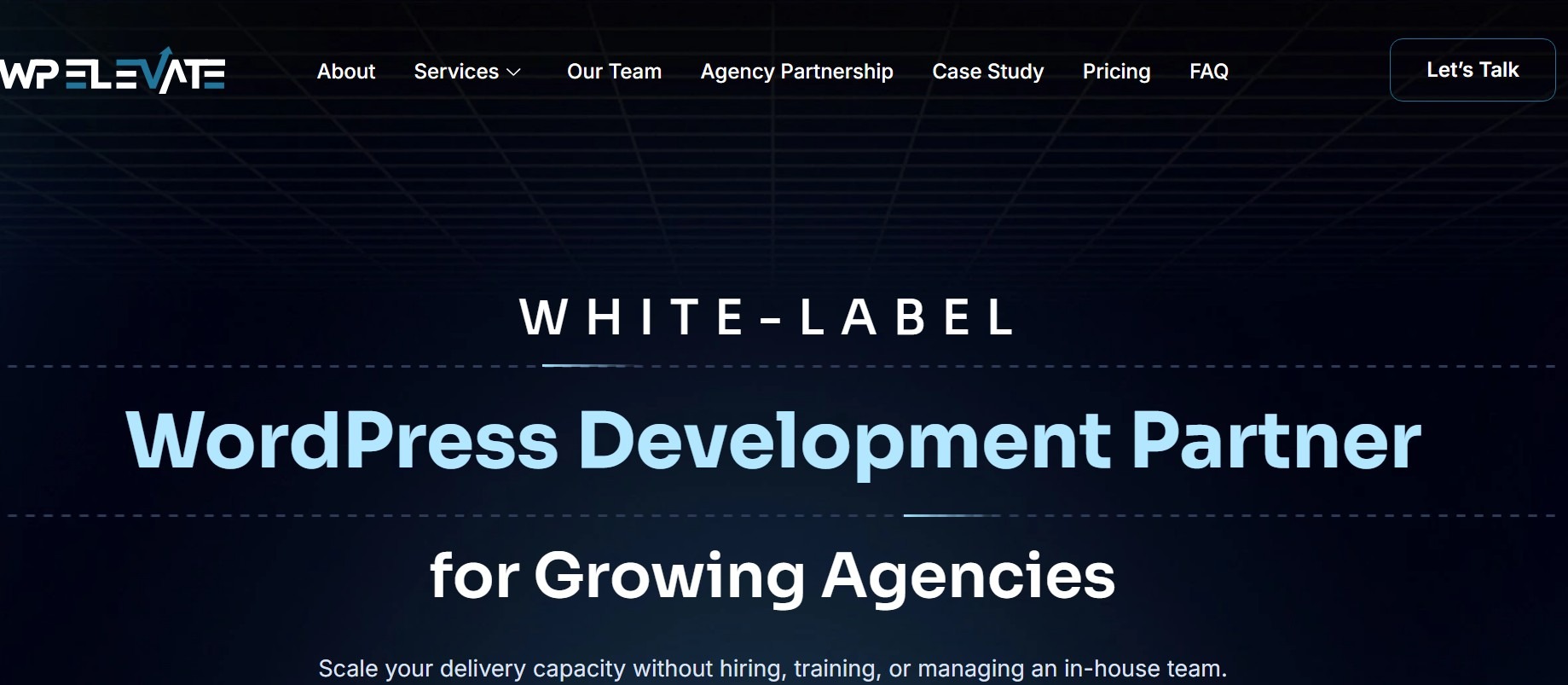
The WP Elevate also works exclusively with agencies and focuses heavily on WooCommerce. Its services cover everything from store setup and custom themes to checkout, integrations, migrations, performance, and ongoing support.
Core offerings:
- WooCommerce store setup
- Custom theme development
- Checkout and cart customization
- Payment, shipping, and tax integrations
- Performance optimization
- WooCommerce migrations
Strengths: Strong WooCommerce focus and a clear agency-only delivery model.
Weaknesses: Its service offering is more focused on WooCommerce than broader web development.
Verdict: Worth considering if WooCommerce is the main requirement and the agency wants a specialist partner.
3. White Label IQ

White Label IQ comes from an agency background and offers WooCommerce alongside other eCommerce platforms and development services. Its WooCommerce offering includes custom development, integrations, performance work, and technical support.
Core offerings:
- WooCommerce development
- Ecommerce store development
- Custom development
- Integrations
- Website maintenance
- QA and technical audits
Strengths: Broad technical range and experience working with agencies.
Weaknesses: WooCommerce is one part of a much wider service offering, rather than its only specialization.
Verdict: A reasonable choice for agencies that need WooCommerce alongside other development services.
4. GetDevDone
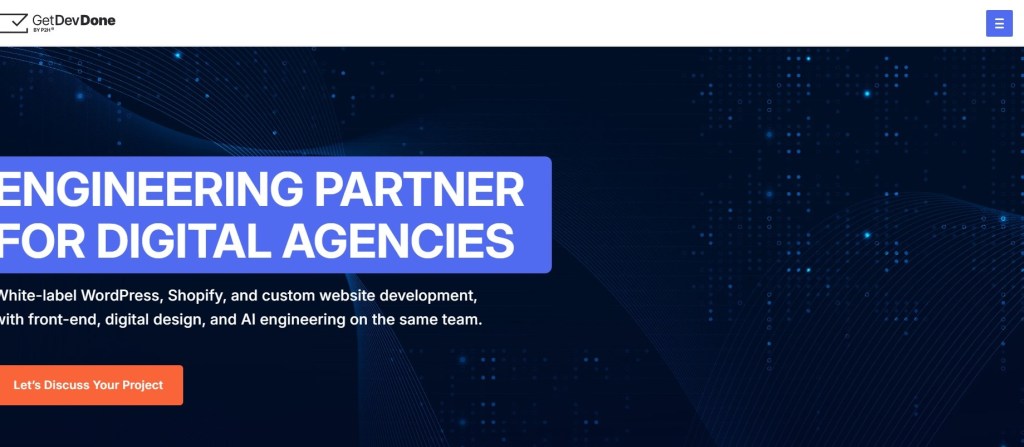
GetDevDone offers WooCommerce development services in storefronts, migrations, integrations, performance, maintenance, and release management. It also supports white-label delivery services, where the agency maintains the ownership of communication with clients.
Core offerings:
- Custom WooCommerce storefronts
- Store migrations
- Payment and business-system integrations
- Performance optimization
- Maintenance and support
- QA and release management
Strengths: Broad technical coverage and a structured delivery process.
Weaknesses: Its WooCommerce offering sits within a broader development operation rather than an agency-only WooCommerce model.
Verdict: A good fit for agencies handling larger or technically involved WooCommerce projects.
5. White Label Coders
White Label Coders has been offering WordPress and WooCommerce services for many years. Its WooCommerce services include scoping, development, deployment, themes development, configuration, plugins, and customization services.
Core offerings:
- WooCommerce development
- Custom theme development
- Store configuration
- Plugin implementation
- Custom frontend and backend work
- Ecommerce deployment
Strengths: Long-standing WooCommerce experience and a broad development skill set.
Weaknesses: Its public offering covers WordPress development more broadly, so WooCommerce is not its only focus.
Verdict: A suitable option for agencies looking for an experienced WordPress and WooCommerce development team.
Questions to Ask Before Choosing a Partner
Before you hand over a WooCommerce project, get clear answers to these questions.
- Who is going to develop my website? Learn who are the actual developers working on your website, not only who manages the account.
- How experienced are they in working with WooCommerce? They should have some experience in working with the store itself, not only WordPress.
- How do they scope custom solutions? Inquire how they approach features development which is not included into the regular WooCommerce functionality.
- How do they handle scope changes? The developer should clarify how changes in scope of work are estimated and accepted.
- Who will be responsible for testing? Confirm that testing is included into the development process.
- What are they going to test before launching the website? Inquire about checkout, payments, shipping, orders, forms, mobile view and integration testing.
- How do they solve payment or checkout issues? Such issues require an expert in troubleshooting them.
- Will the same developer stay on the project? Consistency can make communication and handoffs much easier.
- What happens if that developer is unavailable? There should be someone else who can pick up the work.
- Will they contact the client directly? The answer should be clear if the work is meant to stay white label.
- Who owns the code and credentials? Make sure access and ownership are agreed before development begins.
- What support is available after launch? Know who handles bugs or technical issues once the store is live.
Ask for specific answers. Vague promises about quality, timelines, or support are not very useful when you are responsible for the client.
What Does Good White Label WooCommerce Delivery Look Like?
You should be able to hand over the technical work without having to manage every step yourself.
- The partner understands the project before development starts. Requirements and dependencies should be clear before anyone starts building.
- Technical problems are raised early. You should hear about a development issue before it affects the deadline.
- Estimates are clear. You should know what is included and what falls outside the agreed scope.
- The agency gets regular updates. You should not have to chase the partner to find out what is happening.
- The site is properly tested before launch. Core shopping and checkout flows should be checked before the client sees the finished store.
- The agency gets the files, access, and documentation it needs. Nothing important should be locked away with the development partner.
- Post-launch problems have a clear owner. Everyone should know who handles bugs and technical issues after launch.
- The partner follows the agency’s client communication rules. The client should continue dealing with the agency.
- The agency does not have to manage the developer. That is one of the main reasons for bringing in a white-label partner in the first place.
Conclusion
Executing WooCommerce projects can be challenging if the agency lacks relevant experience or sufficient development capability. However, this doesn’t mean that the agency has to decline the project or hire more developers every time demand surges.
By engaging a white label development partner, the agency can focus on client relations, strategy, design, scope, and sign-off, while the partner focuses on the technical tasks. What matters most is finding a white label partner with a strong grasp over WooCommerce.
All in all, the partner should ultimately help facilitate development processes rather than present an additional stress to manage.