If you’re thinking about finalizing that partnership with a white label WordPress development service, you’ve probably considered several aspects. But have you considered the most important ones adequately?
For instance, the rate on the proposal is rarely the full cost of outsourcing WordPress development. Rework adds hours and QA takes longer when the first build is unreliable. As a result, your project manager might end up chasing updates, reviewing fixes, and managing revision cycles.
Further, a missed deadline can create another round of client calls. Scope gaps create their own problems.
So yes, a partner quoting $25 an hour may look cheaper than one quoting $40. This comparison means very little if the $25 team needs twice the oversight and sends back builds that require repeated fixes.
Partner selection is really a delivery and risk decision. The question is not just who can build the site for less. It is whether they can take work off your delivery team without putting more work back on it.
Choosing a White Label WordPress Partner: 20 Things to Consider
The checklist below looks at what actually matters before you hand over client work: technical capability, QA processes, communication, security, documentation, capacity, pricing, turnaround times, and how well the partner fits into your existing delivery workflow.

1. Check Their WordPress Development Depth
Do they build more than just themes, page builders, and basic plugin configurations? Check if they have real experience working with custom themes and plugins, WooCommerce, APIs, Gutenberg, migrations, and complex integrations. Your chosen partner must be able to provide the technical depth needed for your agency’s WordPress projects.
2. Check References from Other Agencies
Request referrals from other agencies who used them for their outsourced WordPress projects. What were the deadlines like? How responsive was their team? How did they handle revision requests or technical issues? Agency referrals will give you much better insight into the white label delivery process.
3. Review Their WordPress Portfolio
Don’t settle for pretty pictures of the homepage only. Find examples of their work that are similar to what your agency is selling, and look for technical details when possible. You want to know what they delivered. A company showing off someone else’s work as their own is an immediate warning sign.
4. Break Down the Pricing Model
Clarify exactly what is included in the rate they quoted you. Revisions, testing and QA, support and maintenance, urgent requests, integrations, and out-of-scope work need to be addressed. The low cost of development will likely grow quickly as these factors come into play.
5. Check Their Custom WordPress Development Experience
What if each of your projects requires custom themes and plugins? Do their developers know how to design custom themes, plugins, functionalities, and integrations without adding unnecessary technical debt?
6. Check the Team Structure and Capability
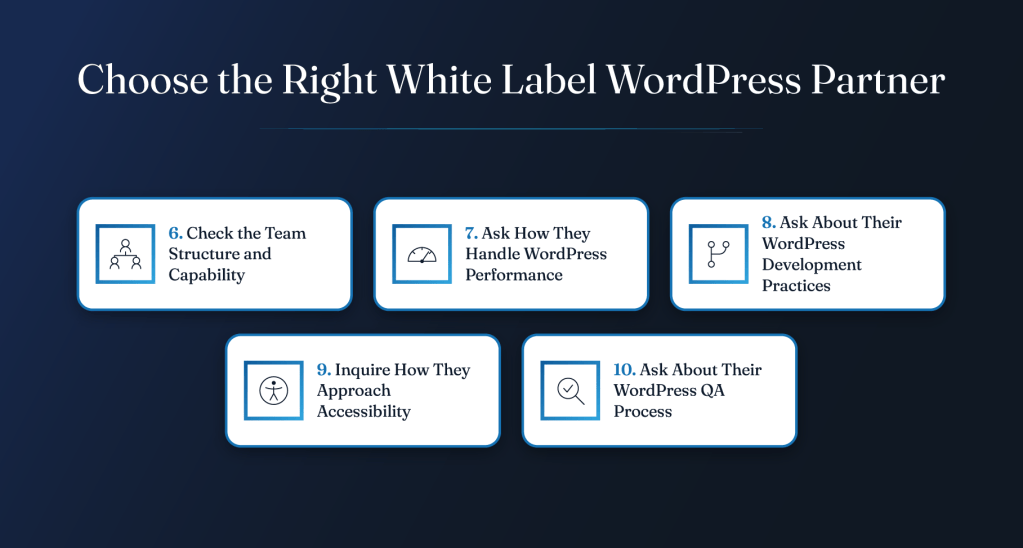
Who will really perform the work on your projects? Ask about developers, designers, QA specialists, project managers and technical leads. You have to know if the team is equipped enough to manage projects even when one of your team members cannot join the task.
7. Ask How They Handle WordPress Performance
Gauge how they handle the performance of their sites during the development/build stage, not after they fail a PageSpeed test. Find out if they consider image optimization, caching, database requests, scripts, hosting, Core Web Vitals, and plugins’ performance during development.
8. Ask About Their WordPress Development Practices
How do they manage version control, coding standards, staging, backup, documentation, deployment, and updates of plugins? You want a consistent development process, and not just developers doing things differently on every project. Adhering to healthy practices makes the site easier to maintain, update, and troubleshoot later.
9. Inquire How They Approach Accessibility
Accessibility shouldn’t be considered as an addition during the final phase of quality assurance. Ask about whether the team takes into consideration WCAG standards during development and how the process of testing works. Things like keyboard navigation, semantic HTML, heading structure, forms, contrast ratio, and screen readers need to be thoroughly tested before launch.
10. Ask About Their WordPress QA Process
Inquire about the QA specialist who will handle the project when the testing stage begins, and the elements that will be checked before your team receives the build. The tests should cover functionality, responsive designs, browsers, forms, links, integrations, and other typical WordPress issues. If developers test their code themselves and clear it, don’t be surprised when your team unearths their mistakes.
11. Ask About Project Management and Communication
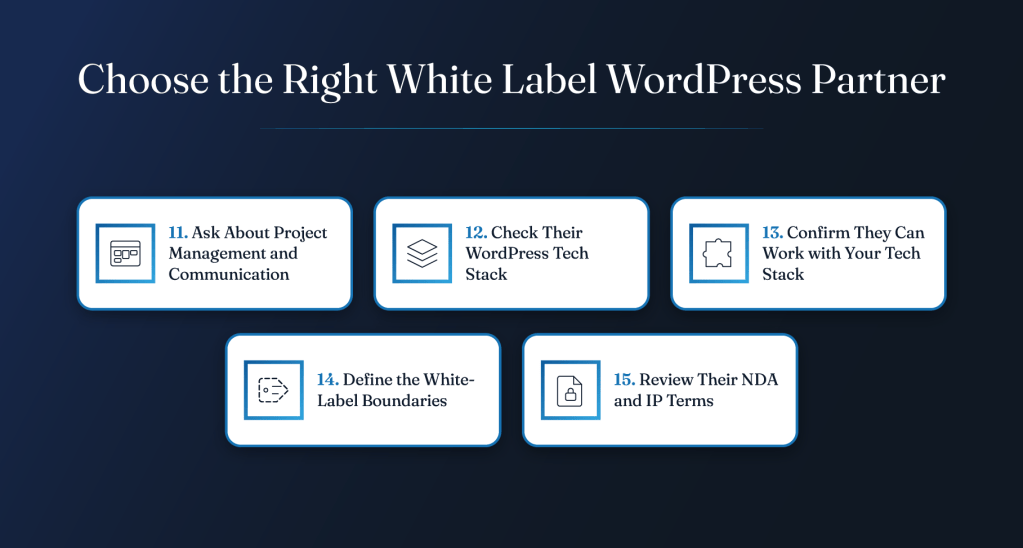
Ask about the project manager and the platform where communication will occur. How often will you get updates? How are blockers reported? Who do you contact in case of critical issues?
You shouldn’t have to pursue your partner for a simple update only to find out that there’s a missed deadline on the day of delivery.
12. Check Their WordPress Tech Stack
Find out about their processes for building and running WordPress projects. Check out which themes, page builders, plugins, development tools, version control system, hosting environment, and deployment processes they use. It is totally okay if their process doesn’t exactly match yours; just make sure you know exactly what you’re bringing into your delivery pipeline.
13. Confirm They Can Work with Your Tech Stack
Your agency might already have its preferred hosting, plugins, CRM software, analytics tools, APIs, or development process. Check if the partner can accommodate these requirements instead of making you move everything to their preferred system. Inquire about experience with integration into a similar ecosystem, especially when your projects depend on third-party services.
14. Define the White-Label Boundaries
State clearly where their role begins and ends. Specify that you will remain in charge of maintaining client relationships. Clarify whether the partner can contact clients, whose branding appears in deliverables, how credentials are handled, and what they can say about the engagement. The scope of the partner’s involvement must be clarified before any client-facing activities start.
15. Review Their NDA and IP Terms
Do not consider the NDA as something to go through and put aside. Find out who has the right to the ownership of the code, designs, documentation, credentials, and client data at the end of the project. Additionally, find out if the partner can reuse the code or show the work in their portfolio.
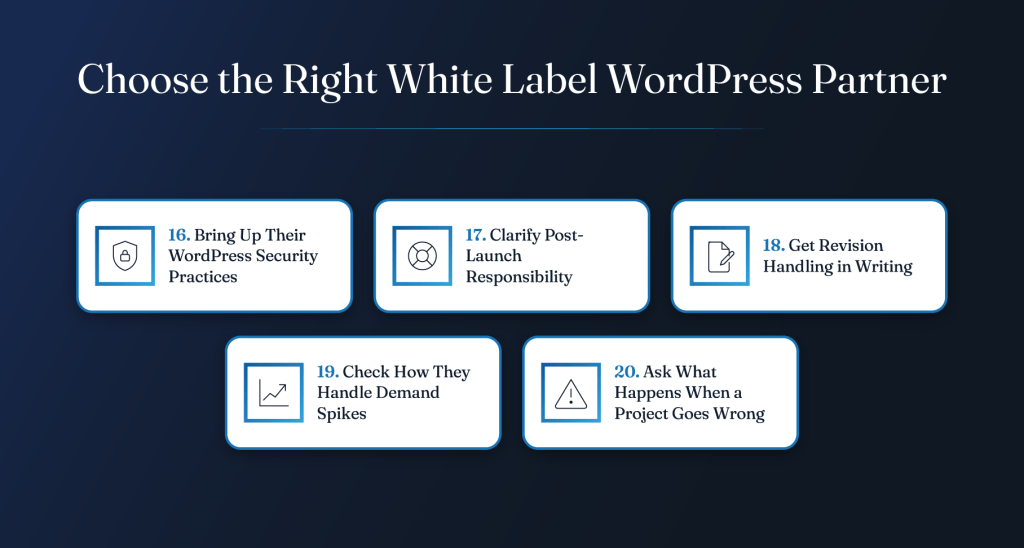
16. Bring Up Their WordPress Security Practices
Ask about their approach to credentials, user permissions, staging environment, backups, plugin vulnerabilities, and access to production. Ask who gets access to the client’s website and how the access will be removed later. WordPress security is a crucial aspect of vendor due diligence, especially when a partner deals with multiple client environments.
17. Clarify Post-Launch Responsibility
The partner’s responsibilities do not end once the website goes live. Define who will be responsible for fixing bugs, WordPress and plugins’ compatibility issues, updates, maintenance, and urgent fixes. Ask about working hours, response time, and escalations. This information should be documented before the project launch while everyone’s excitement is still building up.
18. Get Revision Handling in Writing
Establish what constitutes a revision and what is considered a change request. Find out how feedback is summarized, approved, and made billable. If you don’t have clear revision policies in place, small client requests might gradually become unpaid development hours for your company.
19. Check How They Handle Demand Spikes
Workload fluctuations are common in the agency way of life. One month you might be slow, while in the next, you’ll need to launch several builds at once. Find out how the partner copes with such changes without stretching the same developers on all projects. Inquire about available capacity, backup resources, prioritization, and realistic turnaround times during busy periods.
20. Ask What Happens When a Project Goes Wrong
Request for a real work example where there were delays, technical difficulties, scope issues, or major rework needed. Gauge how they describe the situation. Are they accepting responsibility, explaining the corrective action taken, and changing the process? Or does every problem somehow belong to the client, developer, or project manager?
How to Score the Shortlist
A checklist is useful only if it helps you make the final call. Once you have responses from each partner, score them against the same criteria rather than relying on gut feel or whichever proposal looks cheapest.
- Use one scoring system. Rate each criterion on a 1-to-5 scale. Use the same criteria when rating each partner, so you can compare them on a level playing field.
- Weight the criteria that can hurt delivery. Technical capabilities, reliability, communications, security, QA, and capacity need to be weighted higher than pricing and portfolio presentation.
- Score evidence, not promises. A partner claiming 24/7 support cannot be fully rated until you actually see their response time, escalation processes, and examples of their support.
- Keep price independent of delivery risk. A low bid must not make up for any shortfall in terms of quality assurance, communication, capacity, and project management. These shortcomings will definitely manifest themselves as cost overheads for your agency in the future.
- Mark the deal-breakers independently. Security issues, undefined IP ownership rights, a lack of confidentiality, inability to support your stack of software, or reluctance to do business under your white-label terms should not average out because of a good score in another area.
- Evaluate the pattern of scores, not just the sum total of points. An agency with an overall score of 90, but poor marks for security and reliability, may be a worse option than another with an 84 rating and no major faults.
The final shortlist should answer a practical question: Which partner can take on client work without creating another delivery problem for your agency?
Conclusion
The right partner is not necessarily the one with the lowest rate or the most impressive portfolio. You need a team that can fit into your delivery process, handle client work reliably, communicate without constant chasing, and stay accountable when something goes wrong.
That is what separates a useful white label WordPress agency from yet another vendor on your spreadsheet. The 20 checks above give you a consistent way to assess technical depth, pricing, QA, security, capacity, communication, and the less obvious operational risks.
Score the shortlist, challenge the claims, and run a test project before committing significant client work. A little due diligence upfront is considerably cheaper than repairing a delivery relationship halfway through a client engagement.