If you’re building or planning to build a website for your business, try imagining two websites that go live on the same day with the same design, images, copy, and hosting. One loads effortlessly in under two seconds. The other drags past six seconds, stuttering its way onto the screen like it’s carrying baggage from the dark ages.
You might think that the server or the images are causing the lag. But then you find out, it’s the WordPress page builder running underneath.
Most people commonly pick a WordPress website builder for convenience. Drag, drop, publish, and they’re done. And to be fair, today’s drag-and-drop WordPress page builder tools have made building faster than ever. But, as a white label web development agency, we can tell you that speed during creation is not the same as speed in production.
Many WordPress page builder plugins tend to pile on excess code, bloated scripts, and unnecessary DOM elements. It’s invisible while you build, but once your WordPress site builder setup goes live, the hidden weight shows up in the only place that matters, performance (in other words, money).
So, choosing the best WordPress page builder or even the best WordPress website builder is not about shiny features. It’s about what happens when your site is under pressure.
As a reliable white label WordPress development company, we’re cutting through the noise and taking a look at how the best WordPress page builders actually perform when it counts.
We’ll break them down based on:
- Load speed
- Code output quality
- Core Web Vitals impact
- Scalability as your site grows
From the best WordPress page builder plugin to every major WordPress landing page builder and WordPress visual builder, we’re putting them all under the microscope.
10 WordPress Page Builders Ranked by Performance
Let’s get into the builders themselves.
As you’ve probably guessed, not all WordPress page builders are built the same. Some are sleek, disciplined, and fast. Others look good on the surface but can sabotage performance when you least expect it.
True performance here is about how each WordPress builder behaves when real traffic hits, pages stack up, and your site finally starts becoming a system.
To eliminate the scope of any white label WordPress mistakes in this regard, let’s start with the ones that take performance seriously.
1. Gutenberg (Block Editor)
Best for: Performance-first websites that value speed over visual flair

If WordPress had a “default setting for speed,” this would be it. Gutenberg is the native editor, baked directly into WordPress, minus the extra abstraction layer and unnecessary complexity.
As a WordPress visual builder, it keeps things clean. The code output is lean, predictable, and close to core WordPress standards. This alone gives it a massive edge over most WordPress page builder plugins.
Performance-wise, it’s hard to beat. Pages load fast because there’s simply less junk under the hood. But here’s what you need to know: Design flexibility is limited out of the box. To push it further, you’ll need additional blocks or custom development. So, while it qualifies as a free WordPress page builder, it would be a mistake to consider it a plug-and-play platform for complex layouts.
2. Bricks Builder
Best for: Agencies and developers who care about performance and control

Bricks doesn’t try to impress you with flashy marketing. It focuses on performance first, and everything else comes second.
This drag-and-drop WordPress builder is built with a clear philosophy: less bloat, cleaner structure, faster output. The HTML is tight and the CSS is controlled. You don’t need to work too hard to keep things optimized.
Among modern WordPress page builder plugins, Bricks stands out for its ease of use. It gives developers control without completely alienating designers, which is a rare balance.
That said, it’s not something you casually pick up in an afternoon. There’s a learning curve, especially if you’re coming from more basic tools.
3. Oxygen Builder
Best for: Custom builds where performance and control matter more than ease of use
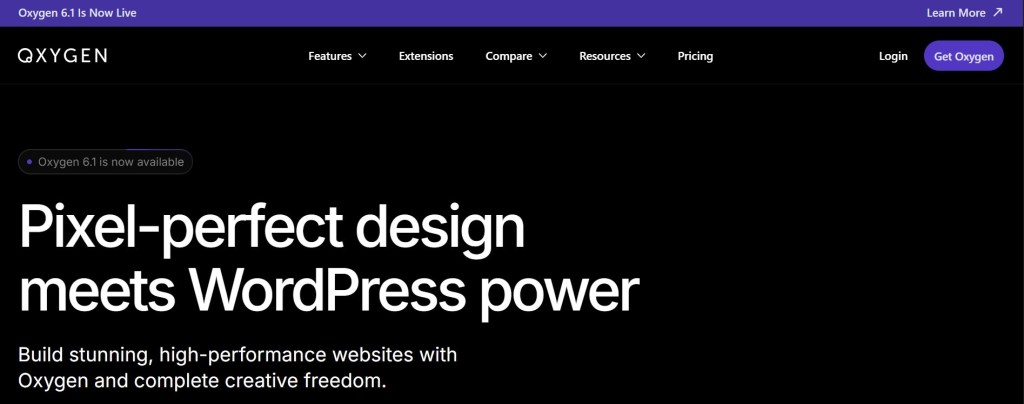
Oxygen swerves from the traditional WordPress website builder playbook. It throws the theme system out of the window and gives you full control over everything. With zero theme dependency, you won’t have to deal with unnecessary layers or WordPress maintenance issues.
The result? Extremely lean output. Pages built with Oxygen are fast because you decide exactly what gets loaded and what doesn’t. In terms of performance, it easily competes with the best WordPress page builder plugin options out there.
But let’s be clear about one thing: it might not be beginner-friendly.
Oxygen expects you to understand structure, layout logic, and at least some level of development thinking. If you’re looking for a simple drag-and-drop WordPress page builder, this isn’t it.
4. GenerateBlocks
Best for: Clean, fast builds that prioritize performance over visual excess

If Gutenberg is the foundation, GenerateBlocks is the upgrade that sharpens it.
Built as a lightweight extension, it enhances the native experience without weighing it down with unnecessary scripts or bloated styling layers. You get a clean, focused add-on to an already efficient WordPress visual builder.
Among free WordPress page builder plugins, this is one of the rare ones that respects performance. The CSS and JavaScript footprint stays minimal, which keeps load times tight and predictable.
However, design flexibility is limited. You won’t get the same visual freedom as a full-fledged WordPress landing page builder. But what you do get is control, speed, and stability.
5. Kadence Blocks
Best for: Marketers and teams that want flexibility without completely sacrificing speed
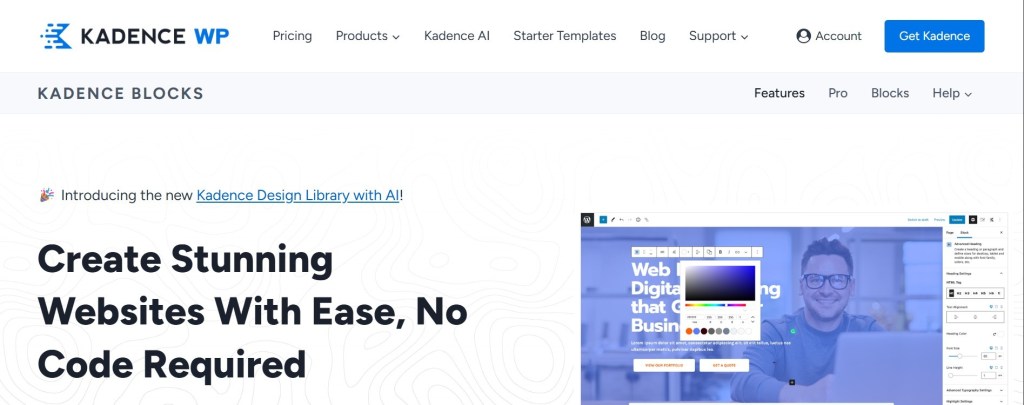
Kadence Blocks isn’t as barebones as GenerateBlocks, nor is it as heavy as the bigger players. It’s that rare middle ground where usability and performance join hands without too much hassle.
As part of the broader WordPress page builders ecosystem, it brings more design flexibility while still keeping performance in check. Yes, it’s slightly heavier than GenerateBlocks, but compared to most WordPress page builder plugins, it holds its ground well.
It also leans into a more beginner-friendly approach, making it a scalable website builder for WordPress for teams that include non-technical users.
6. Elementor
Best for: Design-heavy websites where flexibility matters more than raw speed

We’ve all had that Elementor vs Gutenberg debate at least once when choosing a website builder. But if there could be a true celebrity in the world of WordPress builders, it’d be Elementor. Everyone knows it and even used it. And clients? They ask for it by name.
It comes packed with features, widgets, templates, and integrations. If you’re looking for a drag-and-drop WordPress builder that can do almost anything visually, Elementor delivers. It’s easily one of the best WordPress page builders when it comes to design freedom.
Under the hood, however, Elementor carries a heavy DOM structure, significant JavaScript usage, and more layers than most WordPress page builder plugins. Left unchecked, it can slow things down.
Can it perform well? Yes, but only if you’re disciplined. Optimization isn’t optional here, it’s survival.
7. Divi
Best for: Users and businesses already invested in the Divi ecosystem

Divi has been around in the WordPress website builder space long enough to build a massive user base.
Unlike most WordPress page builders, it comes bundled with its own theme. This tight integration gives users a unified experience, especially if they’ve already committed to its ecosystem.
To its credit, performance has improved over the years. But it also carries more weight than modern, performance-first tools. You can feel the difference when you compare it to the newer drag-and-drop WordPress page builder options.
In a nutshell, Divi isn’t trying to win the speed race anymore. It’s leaning on familiarity, ecosystem strength, and ease of use.
8. Beaver Builder
Best for: Agencies that value reliability over experimentation

In a space crowded with flashy WordPress page builders, Beaver leans into stability. It’s consistent, predictable, and has become the kind of drag-and-drop WordPress page builder that doesn’t leave you unpleasantly surprised.
Performance-wise, it’s neither the fastest, nor the heaviest. Its footprint is moderate, which makes it manageable across different types of builds. You won’t get cutting-edge output like the newer tools, but you also won’t deal with chaos.
Basically, it’s not trying to be the best WordPress page builder in terms of features. It’s trying to be the one that just works.
9. Breakdance
Best for: Users looking for a modern alternative to heavier builders like Elementor
Breakdance is modern, performance-aware, and built to avoid the mistakes older WordPress page builder plugins made. What you get is a cleaner output, better structure, and less unnecessary weight.
Compared to traditional WordPress visual builder tools, it’s noticeably leaner. It isn’t as raw as developer-focused options, but is far more optimized than legacy builders.
That said, it’s still evolving. Features are growing and the ecosystem is maturing. It hasn’t fully settled into its final form yet. Think of it as a younger contender trying to earn its place among the best WordPress page builders.
10. Thrive Architect
Best for: Landing pages, funnels, and conversion-focused campaigns

Built for marketers, this WordPress landing page builder is packed with elements designed to drive action. It includes countdown timers, lead forms, funnels, you name it. If your goal is clicks and conversions on your eCommerce platform, it delivers (This should resolve your WooCommerce vs BigCommerce conundrum to an extent).
However, all these features bring additional scripts, which affect performance. It’s not slow, but it’s not lean either. It works best when used with intention, not as your entire WordPress site builder.
To give you a holistic snapshot of our discussion so far, here’s a quick comparison table.
| Builder | Best Use Case | Performance | Code Cleanliness | Learning Curve | Agency Fit |
|---|---|---|---|---|---|
| Gutenberg | Performance-first websites | High | Very Clean | Low | High |
| GenerateBlocks | Lightweight, fast builds | High | Very Clean | Medium | High |
| Kadence Blocks | Balanced flexibility + speed | Medium-High | Clean | Low | High |
| Bricks Builder | Developer-focused builds | High | Very Clean | Medium-High | High |
| Oxygen Builder | Fully custom builds | High | Extremely Clean | High | High |
| Breakdance | Modern visual building | Medium-High | Clean | Medium | Medium-High |
| Beaver Builder | Stable agency workflows | Medium | Clean | Low | High |
| Elementor | Design-heavy websites | Low-Medium | Moderate | Low | High |
| Divi | Legacy ecosystem users | Low-Medium | Moderate | Low | Medium |
| Thrive Architect | Funnels & landing pages | Medium | Moderate | Low | Medium |
Performance Tiers: A Grouped Overview
Now that you’ve seen each builder in isolation, the pattern becomes clearer when you zoom out. Not all WordPress page builders compete on the same playing field. Some are built for speed, while others trade speed for flexibility, and a few try to do everything only to end up carrying extra weight.
Here’s how they naturally group themselves.
1) High-Performance Builders
These are the ones that respect the fundamentals, like clean output, minimal overhead, and strong Core Web Vitals by default.
Gutenberg, GenerateBlocks, Bricks, and Oxygen find a place here. If your priority is building a lean WordPress site builder setup that scales without trouble, this should be your pick.
2) Balanced Builders
This tier walks the middle path. You get decent flexibility without completely sacrificing performance.
Kadence Blocks, Breakdance, and Beaver Builder fall into this category. They’re solid website builders for WordPress options when you need usability and speed to coexist.
3) Heavy but Usable Builders
Experienced white label web design teams are aware that these tools offer strong capabilities but come with a heavier footprint. Elementor, Divi, and Thrive Architect belong here. They can still work as a best WordPress website builder choice if handled carefully, but they demand strict optimization discipline.
Best Page Builder Stacks for Agencies (Based on Use Case)
Choosing a single best WordPress page builder depends on various factors because agencies don’t operate in a vacuum. Different clients have different goals as well as different constraints. What actually works is building right stack for the job.
1) Performance-First Stack
Gutenberg + GenerateBlocks
This combination keeps your WordPress builder setup clean, fast, and scalable. Ideal for content-heavy or SEO-driven projects where performance is non-negotiable.
2) Design-Heavy Client Work
Elementor with a strict optimization framework
Elementor still earns its place among the best WordPress page builders for visual flexibility. But without clear SOPs for performance, it can spiral quickly.
3) Developer-Led Custom Projects
Bricks or Oxygen
When control matters more than convenience, these tools step in. They behave more like WordPress theme builder software than typical drag and drop WordPress builder tools, giving developers full command over output.
4) Conversion-Focused Marketing Funnels
Thrive Architect
For campaigns, landing pages, and funnels, this WordPress landing page builder is built to convert. It’s not your full-site solution, but it excels in its niche.
5) Balanced Agency Stack
Kadence Blocks + selective use of Elementor
This setup gives you flexibility without going all-in on heavy tools. A practical best WordPress site builder approach for mixed client needs.
6) Scalable Hybrid Approach
Standardize one core stack. Use secondary tools only when required.
Instead of chasing every new best WP page builder, mature agencies build systems to prioritize consistency first, exceptions second.
How We Evaluated These Page Builders
Every WordPress page builder here was evaluated under the same conditions to keep things fair. That way, differences in performance come from the builder itself, not the design.
To measure results, we used:
- PageSpeed Insights
- GTmetrix
These tools helped break down how each WordPress visual builder behaves beyond surface-level speed.
Metrics analyzed:
- Load time
- DOM size
- CSS and JavaScript weight
- Render-blocking resources
But numbers alone don’t tell the full story. So, we also looked at real-world factors that affect how a website builder WordPress setup performs after launch.
Real-world considerations:
- CDN and caching compatibility
- Impact of third-party add-ons
- Ease of optimization
Because in reality, no best WordPress theme builder exists in isolation. What matters is how well it holds up once plugins, scripts, and actual business needs start stacking on top of it.
How to Choose the Right Page Builder
The right WordPress page builder decision isn’t about convenience, but about workflow. Consider how your team builds, ships, and scales over time. As such, once a WordPress website builder is baked into your system, switching can prove to be expensive, and cumbersome.
Start by matching the builder to the project. For performance-first builds, lean toward block-based setups or developer-focused tools. A lean WordPress builder like Gutenberg paired with lightweight extensions, or something like Bricks or Oxygen, keeps your foundation clean and scalable.
For design-first projects, visual tools make sense. A drag-and-drop WordPress page builder like Elementor can absolutely deliver, but only if you treat optimization as part of the process, not an afterthought.
Remember, migration is painful. Switching from one best WordPress page builder plugin to another later means rebuilding layouts, fixing styling issues, and often losing performance gains. It’s not a tweak, it’s a reset. So, choose wisely.
The smartest teams don’t chase the best WordPress website builder. They build systems around a few reliable tools and scale from there.
Common Mistakes That Kill Performance (Regardless of the Builder)
You can pick the best WordPress page builders on the market and still end up with a slow, unwieldy site not because the tool failed, but because the setup didn’t perform.
Performance isn’t just about the website builder for WordPress. It’s about everything layered on top of it.
- Too many add-ons. Every extra plugin, every shiny extension, adds weight. Even a clean WordPress visual builder can turn sluggish when overloaded with unnecessary features.
- Ignoring image optimization. High-resolution images straight from design files will crush load times. No free WordPress page builder or premium tool can save you from that.
- Poor hosting. You can build the fastest WordPress landing page builder setup in the world, but if your server struggles, your site struggles. Simple as that.
- Caching and CDN neglect. Skipping these is like building a fast car and refusing to fuel it properly. Any drag and drop WordPress builder benefits massively from proper caching and content delivery networks.
- Over-designing. Too many animations, sections, and elements layered on top of each other. It looks impressive in the editor, but in reality, it slows everything down. Even the best page builders for WordPress can’t compensate for excess.
At the end of the day, performance is a system. The best WordPress site builder helps, but it won’t save you from bad decisions.
Conclusion
At the end of the day, WordPress page builders aren’t just tools. They shape how your site performs, scales, and converts. The flashy drag-and-drop WordPress page builder you choose today can either support your growth or quietly slow it down tomorrow.
There’s no single best WordPress page builder. Only the one that fits your workflow, your clients, and your long-term goals. Choose with clarity, not convenience.
If you’re an agency looking to scale without getting buried in builds, this is where AgencyMinds steps in. With our white label WordPress development solutions, we handle execution while you focus on growth.